Developing the Next Generation of Polar-Orbiting and Low-Earth-Orbiting Operational Environmental Satellites: A Collaborative Effort between NOAA, NASA and Industry Partners
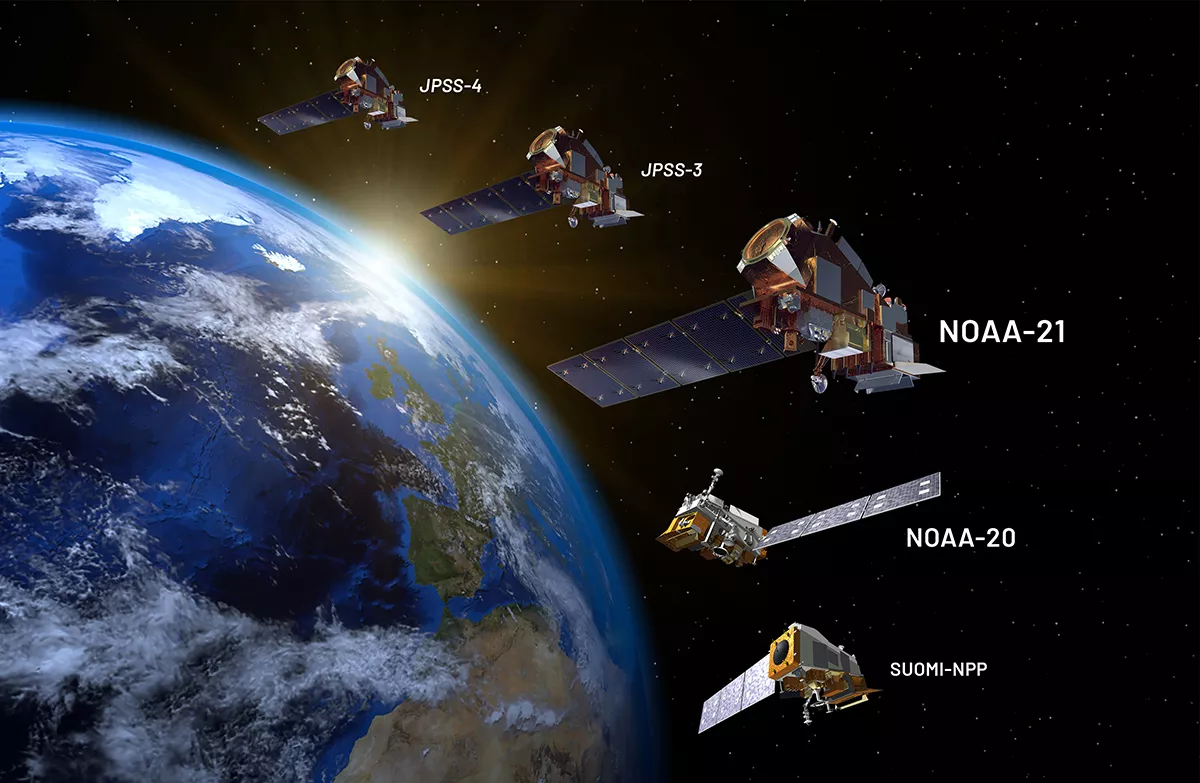
The Office of Low Earth Orbit (LEO) Observations includes two programs: the Joint Polar Satellite System (JPSS) and the Near Earth Orbit Network (NEON).
Joint Polar Satellite System (JPSS)
The Joint Polar Satellite System (JPSS) is the nation’s advanced series of polar-orbiting environmental satellites. Considered the backbone of the global observing system, JPSS satellites circle Earth from pole to pole and cross the equator 14 times daily—providing full global coverage twice a day.
NOAA’s National Weather Service uses the collected data to increase the accuracy of forecasts three to seven days in advance of a severe weather event. JPSS satellites also provide support for operational forecasting. JPSS also enables scientists and forecasters to study long-term climate trends by extending the more than 30-year satellite data record.
Information from JPSS satellites supports every aspect of NOAA’s mission, ensuring a more “Weather-Ready Nation” and providing global measurements of conditions in the atmosphere, in the oceans, and on land.
Near Earth Orbit Network (NEON)
NOAA’s Near Earth Orbit Network (NEON) Program will develop future low-Earth orbit (LEO) environmental satellites. Low and medium Earth observations are critical for weather forecasting, environmental observation, climate monitoring, and public safety. NEON sets the stage for NOAA to manage future polar and other low Earth and medium Earth orbit satellite observations as loosely coupled projects.
The NEON Program will supplement and eventually replace NOAA’s Joint Polar Satellite System (JPSS). JPSS will continue to operate its series of polar orbiting satellites through the late 2030’s. NEON will lay the groundwork for the next generation of LEO satellites long before the final JPSS launch takes place. NEON will continue, improve, and extend NESDIS’ global observations for weather forecasting, disaster management, and climate monitoring.
Our Leadership
Divisions
Within the Office of LEO Observations, there are four projects supporting the JPSS Program and NEON Program.
JPSS Flight Project
The JPSS Flight project designs, builds, tests, and launches satellites in the JPSS system. Between 2011 and 2032, this project will launch five satellites: Suomi National Polar-orbiting Partnership, the technology demonstration for JPSS, launched in 2011; JPSS-1, now called NOAA-20, launched in 2017; JPSS-2, now called NOAA-21, launched in 2022; JPSS-3; and JPSS-4. These satellites carry four or more instruments that gather global measurements of atmospheric, terrestrial, and oceanic conditions, including sea and land surface temperatures, vegetation, clouds, rainfall, snow and ice cover, fire locations and smoke plumes, atmospheric temperature, water vapor, and ozone.
JPSS delivers key observations for the nation's essential products and services, including forecasting severe weather like hurricanes, tornadoes, and blizzards days in advance, and assessing environmental hazards such as droughts, forest fires, poor air quality, and harmful coastal waters. Further, JPSS will provide continuity of critical, global observations of Earth’s atmosphere, oceans, and land through 2038.
NEON QuickSounder Project
The first project in the NEON Program series is QuickSounder. This pathfinder mission will demonstrate the ability to launch a small satellite within three years. QuickSounder will fly a refurbished Advanced Technology Microwave Sounder (ATMS) instrument, the same as those flown on the JPSS series of satellites.
NEON Series 1 Project
The second NEON project, Series 1, will fly the program’s first new instrument, the Sounder for Microwave-Based Applications (SMBA). SMBA will serve as the backbone microwave sounder for the NEON Program.
LEO Ground Project
The Ground Project maintains a modern ground system to support Suomi NPP, NOAA-20, NOAA-21, and a diverse set of low Earth-orbiting satellites used for operational weather forecasting, environmental monitoring, and climate research. Developed by NASA on behalf of NOAA, the Ground Project features high data capacity, low data latency, improved data quality, and high operational availability to meet the nation’s critical needs for accurate and timely weather forecasting. It is designed to provide satellite constellation management, mission planning and scheduling, satellite command and control, data acquisition, data routing, data processing, product generation and distribution, and system sustainment services. In addition, the Ground Project provides instrument and data product calibration and validation functions and supports field terminal users with software, documentation, and operations support data.
The data products produced by the Ground Project include detailed cloud coverage, atmospheric temperature and pressure, ozone distribution, as well as snow cover, vegetation, aerosols, and Earth radiation budget information. This wealth of information enables numerous users to monitor and predict changes in weather, climate, and ocean conditions.
Partners
The Office of LEO Observations (LEO) works closely with both national and international partners—operational users, researchers, and other end users—to facilitate effective collaborations to make data readily available to support weather operations and long-term research, as well as to ensure that partners are prepared to utilize that data.
LEO engages with partners in all facets of the program, including scientific research, user requirement reviews, and operational and research distribution. LEO also regularly interacts with its partners at scientific conferences and through program outreach efforts. In interactions with NOAA operational users, LEO learns and understands their requirements, allowing LEO to provide satellite products that meet those operational needs and support real-time weather operations.
LEO also works closely with other users within the federal government and the international user community. The program assists in applying scientific research to ensure that the data and products are of the highest quality. The program is also positioned to leverage continuing work from the NOAA research agencies and other national research organizations as well as the NOAA Cooperative Institutes.
LEO’s Direct Broadcast partners are a critical part of the office's success. This partnership ensures that antennas and algorithms are available to provide critical data quickly to data-sparse areas of the globe.
LEO has a robust user engagement strategy that provides a framework for all manner of user engagement efforts for LEO’s next generation of operational satellites, the Near Earth Orbit Network (NEON). Engaging with the broad set of future users of LEO observations under the NEON program is an integral part of ensuring mission success through various stages of the program life cycle. LEO developed a NEON User Engagement Plan that describes the approach to continuously interact with future NEON stakeholders to understand their missions and be able to respond to their future requirements.
LEO data is critical to protecting U.S. lives and property and the program is committed to providing this vital data to help minimize the impacts of weather and environmental hazards.
LEO News
-
Nighttime VIIRS imagery is useful in detecting and characterizing natural gas flares, aiding in…
-
On October 14, 2023, an annular, or ring-shaped, solar eclipse passed through Albuquerque, New…
-
NOAA-21 is now operating as the primary satellite in NOAA’s advanced Joint Polar Satellite System,…
Workshops and Training
-
Jun 18, 20241:00pm - 4:00pmThe American Meteorological Society (AMS) Committee on Satellite Meteorology, Oceanography, and…
-
Jun 25, 20241:00pm - 4:00pmThe American Meteorological Society (AMS) Committee on Satellite Meteorology, Oceanography, and…
-
Jun 27, 20241:00pm - 4:00pmThe American Meteorological Society (AMS) Committee on Satellite Meteorology, Oceanography, and…